
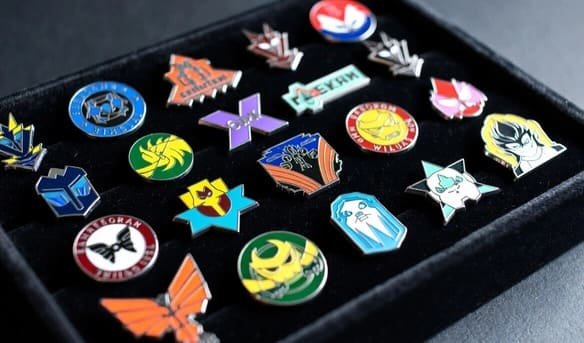
TL;DR: Custom lapel pins usually run $0.80 to $5.00 per pin. The spread depends on quantity, manufacturing process, size, and color count, in roughly that order of impact. A standard 1-inch soft enamel pin lands around $2.00–$3.00 each at 100 units and drops below $1.50 at 500. Mold fees ($30–$150) and add-ons (epoxy, custom backing) move the final total more than most buyers expect.
The Honest Price Range at Common Order Sizes
A standard 1.25-inch soft enamel pin costs about $2.75 to $3.24 at 100 units and drops to roughly $1.00 to $1.60 at 500. Between manufacturers the totals swing wildly because of setup fees and where the factory actually sits.
Most “starting at $0.85″ marketing teasers want you ordering 3,000 to 5,000 units. Below is a 2026 price matrix for an identical spec sheet (1.25”, soft enamel, 4 colors, standard plating, butterfly clutch) across four established vendors.
| Quantity | All About Pins | Challenge Coin Country | The Pin Creator | Metro Pins |
|---|---|---|---|---|
| 100 | $3.24 | $2.92 | $2.72 | $2.75 |
| 200 | $2.68 | $2.42 | $2.15 | $2.19 |
| 300 | $2.00 | $1.80 | $1.52 | $1.49 |
| 500 | $1.61 | $1.45 | $1.01 | $1.06 |
| 1,000 | $1.37 | $1.23 | $0.81 | $0.86 |
Vendors at the top of the spread (All About Pins is the obvious one) waive the initial mold fee and throw in priority air shipping. Cheaper vendors will quietly add $50 to $100 for the mold at checkout, which closes most of the gap.
The Six Variables That Actually Move the Price
Six line items decide the invoice.
1. Order Quantity (50–70% variance). Volume pricing is brutal in metal casting. Going from 100 to 500 units cuts the per-unit price by half across nearly every major supplier I’ve quoted.
2. Pin Size (5–15% per quarter-inch). Factories price metal by weight and mold footprint. Standard breakpoints sit at 0.75″, 1.0″, 1.25″, 1.5″, 1.75″, 2.0″. Bumping a 1.0″ design up to 1.25″ adds maybe $0.09 to $0.15 per pin at the 100-unit tier.
3. Color Count ($0.05–$0.19 per extra color). Some vendors give you the first 7 enamel colors free on soft enamel runs. Past that limit the upcharge is strict — usually a flat $19 fee per extra color on the total order, which works out to $0.19 per pin on a 100-piece batch.
4. Plating Type (10–20% variance). Shiny gold, silver, black nickel — all bundled. Dual-plating (two different metals on one pin) needs a secondary masking step, which is genuinely manual work, and the price reflects it.
5. Backing Type ($0.10–$0.35 per pin). Butterfly clutches and rubber clutches are free. Double-magnetic backings, the kind used so the post doesn’t punch a hole through a suit lapel, cost more in both material and assembly.
6. Mold and Setup Fees ($50–$150 flat). The factory has to CNC-machine a steel die to stamp the blanks. Basic 2D die at 1 inch is around $50. Oversized or 3D sculpts can push $150.
Manufacturing Process — Which One You Actually Need (and What It Costs)
Soft enamel is the cheapest custom lapel pin type at roughly $1.38–$3.15 per unit. Hard enamel runs 20–30% more. Die-struck sits in between. Picking wrong is how budgets blow up or how you end up with artwork that looks nothing like the proof.
Soft Enamel. Liquid enamel gets dropped into the recessed areas of the stamped metal, leaving the metal borders raised above the paint. Textured, slightly 3D feel. Cheapest option, holds fine detail well. Use it for retail merch, promo giveaways, and most logos with clean line work.
Hard Enamel. Sometimes still called cloisonné, though the modern process isn’t true cloisonné. The factory overfills the recesses, bakes it at high temperature, and grinds the whole surface flush with the metal borders. Adds 20–30% to the unit cost. This is your option for service awards, premium brand merch, and challenge coins.
Die Struck. Stamped metal, zero paint. The whole design depends on the contrast between raised polished metal and recessed sandblasted metal. Good for fraternities, corporate anniversary pieces, anything where you want the design to read as restrained. Mid-range on price.
Offset Printed. If the design has gradients, CMYK blends, or text under 1mm, enamel will fail you. The factory prints high-resolution artwork directly onto a flat metal blank and seals it under an epoxy dome. Skips the heavy die-stamping step, which is why it’s often the fastest to produce.
Sample Quote, Fully Itemized
Most public price tables hide the checkout additions. Here’s a real, itemized 2026 quote for a mid-tier promotional order.
The Specs:
- Quantity: 250 units
- Size: 1.25 inches
- Process: Soft Enamel
- Colors: 5 Colors
- Plating: Shiny Gold
- Backing: Standard Rubber Clutch
- Packaging: Custom 300gsm Backing Cards
- Extra: Epoxy Dome Coating
The Invoice:
- Base unit cost: 250 @ $1.65 = $412.50
- Die/mold fee: $55.00 (one-time)
- Epoxy dome: 250 @ $0.10 = $25.00
- Backing cards: 250 @ $0.30 = $75.00
- Priority air shipping: $0.00 (waived)
- Subtotal: $567.50
- Landed cost per pin: $2.27
That’s a clean quote. A messier one would have the shipping line populated, plus a customs broker fee at the bottom you didn’t see coming.
Hidden Costs and Upcharges That Surprise First-Time Buyers
This is the section I wish I could hand every first-time buyer before their kickoff call. The five upcharges that catch people: mold fees, epoxy dome upgrades, rush production, PMS color matching, and import tariffs. The first four are predictable once you know to ask. The fifth is where things have gotten messy.
- Epoxy domes. Clear resin poured over a soft enamel pin to stop scratching. Adds $0.03 to $0.15 per unit. Worth it if the pins will be handled daily — keychains, wearables that ride in pockets. Useless on hard enamel, which is already flush.
- Specialty enamels. Glitter fill, glow-in-the-dark, translucent enamel — about $0.10 per pin on top.
- Complex cutouts. Standard dies stamp solid external shapes. Piercing a hole through the middle of the design needs a secondary punch die, $15 to $50 in extra setup. Most first-time buyers don’t realize a “hole in the design” isn’t free.
- Rush fees. Standard production is 14–18 days. Forcing a 7-day turn often runs you a 50% rush surcharge, and you’ll still ship by air on top of that.
- Import tariffs. Base metal lapel pins enter the US under HS code 7117.19.9000, with a base duty rate of 11%. Anecdotally, since the changes to the $800 de minimis exception through 2025 and into 2026, small orders that used to slip through under the threshold are now triggering that 11% plus courier brokerage fees at the door. I’ve seen buyers in the EnamelPins subreddit posting screenshots of 10–21% in surprise charges on what they thought were simple direct-factory orders. Whether the de minimis pause is still in effect when you read this, I genuinely can’t tell you — it’s been changing. Check CBP before you buy direct.
The tariff one is the line item that’s killed the most “I’ll just order from Alibaba” projects in the last 18 months.
Overseas vs. Domestic Manufacturing — True Landed Cost
Comparing US manufacturing to Chinese or Taiwanese manufacturing on strict unit price is lopsided to the point of being useless.
One buyer documented a $32 per-pin quote from a US manufacturer against $4 for the same spec out of China. EPA regulations on metal-plating chemicals make large-scale domestic pin manufacturing economically unviable for standard promotional volumes — the chemistry alone is the dealbreaker, not the labor.
So most “US-based” pin companies are brokers. Artwork, client comms, QC handled stateside; CAD files go to a partner factory in Shenzhen or Taipei. I’ve worked with both sides of this and I’ll say it plainly: the broker model isn’t the scam people think it is. You’re paying for someone to absorb the customs paperwork and eat the tariff surprises.
Landed cost for 250 pins:
- Offshore direct (Alibaba or factory direct): $300 unit cost + $50 shipping + $33 tariff + $25 broker fee = around $408 total. Lead time 4–6 weeks.
- US broker (All About Pins, PinMart, etc.): $567 flat. Shipping and tariffs absorbed or managed by the vendor. Lead time 2–3 weeks.
The broker route is more expensive and faster, and the customs liability isn’t yours.
How to Get the Best Price Without Getting Burned
A short playbook for pulling landed cost down without compromising the hardware.
- Lock the mold for reorders. The biggest single ROI move. Reputable factories store physical molds for 1 to 2 years. Reorder the same design inside that window and the mold fee drops to zero.
- Cap the color count. Keep designs under the 7-color line. A 9-color pin forces manual syringe filling, which spikes the unit cost and slows production.
- Specify black rubber clutches. Butterfly clutches scrape skin and tear thin cotton. Rubber clutches are softer, grip the post tighter, and the swap is usually free. Obviously you wouldn’t spec rubber on a heavy 3D sculpt where the post needs the lock.
- Standardize the size. A 1.05-inch pin gets priced at the 1.25″ tier. Shrink the artwork to land cleanly inside the 1.0″ threshold and you’ll capture the lower bracket.
- Demand a digital proof. Never pay a production invoice without a factory-approved 2D vector proof showing exact PMS codes and raised metal lines. This is the single most common point where things go sideways and the factory will tell you the proof was approved.
- Consolidate orders. Launching three designs? Order them together. Factories often grant the higher-volume discount on total piece count even with distinct molds.
- Ask for DDP terms. When negotiating direct with overseas factories, specify DDP (Delivered Duty Paid). Forces the factory to cover customs clearance and the 11% HS 7117.19 tariff. No surprise UPS bill at the door.
When to Spend More (and When It’s Wasted Money)
Spend more if:
- The pins are executive service awards. Pay the 30% premium for hard enamel. The jewelry-grade flat surface is the whole point.
- They’re going on expensive apparel. Spend the extra $0.25 to $0.50 per pin for double-magnetic backing. Permanent fabric damage from a butterfly post is not worth the savings.
- The design has text under 1mm. Switch to offset printing. Enamel paint will bleed and you’ll lose the text.
Skip it if:
- Soft enamel pins for a backpack or denim jacket. Skip the butterfly clutch — the free rubber clutch grips thick fabric better anyway.
- Hard enamel pins. Skip the epoxy dome. Hard enamel is already polished flat. The dome just makes it look cheap.
- Single-day event giveaways. Skip strict PMS matching and premium backing cards. Baseline soft enamel is fine for something a recipient will lose by Tuesday.
I’ll be honest: I still spec hard enamel for almost every corporate gift order even when the brief says “casual.” Old habit from the agency days, not really defensible on a per-project basis. Hard enamel pins just hold up better in the long tail, and I don’t like getting the email two years later about chipped paint.
FAQ
What’s the minimum order for custom lapel pins?
Standard lapel pin factory minimum is 50 to 100 units. Some vendors advertise 25-unit minimums, but the fixed mold fee pushes per-pin cost to absurd levels at that tier.
Do I have to pay a mold fee every time I reorder?
No. Factories keep your custom steel molds on shelves for 1 to 3 years. Reorder the same design in that window, mold fee drops to zero. This is genuinely the easiest money you’ll save in this category, and it’s the main reason it’s worth getting the first order right rather than swapping vendors every cycle to chase a $0.10 unit-price difference. Pick a vendor you can live with, lock the mold, and reorder against it.
How much does a single custom pin cost if I just want one?
The factory still has to machine the die. A single pin effectively costs $50 to $100.
Are hard enamel pins worth the extra cost?
Yes if the application is formal. The 20–30% premium gets you a smooth flush surface that resists chipping and reads like fine jewelry. Wasted on casual giveaways.